
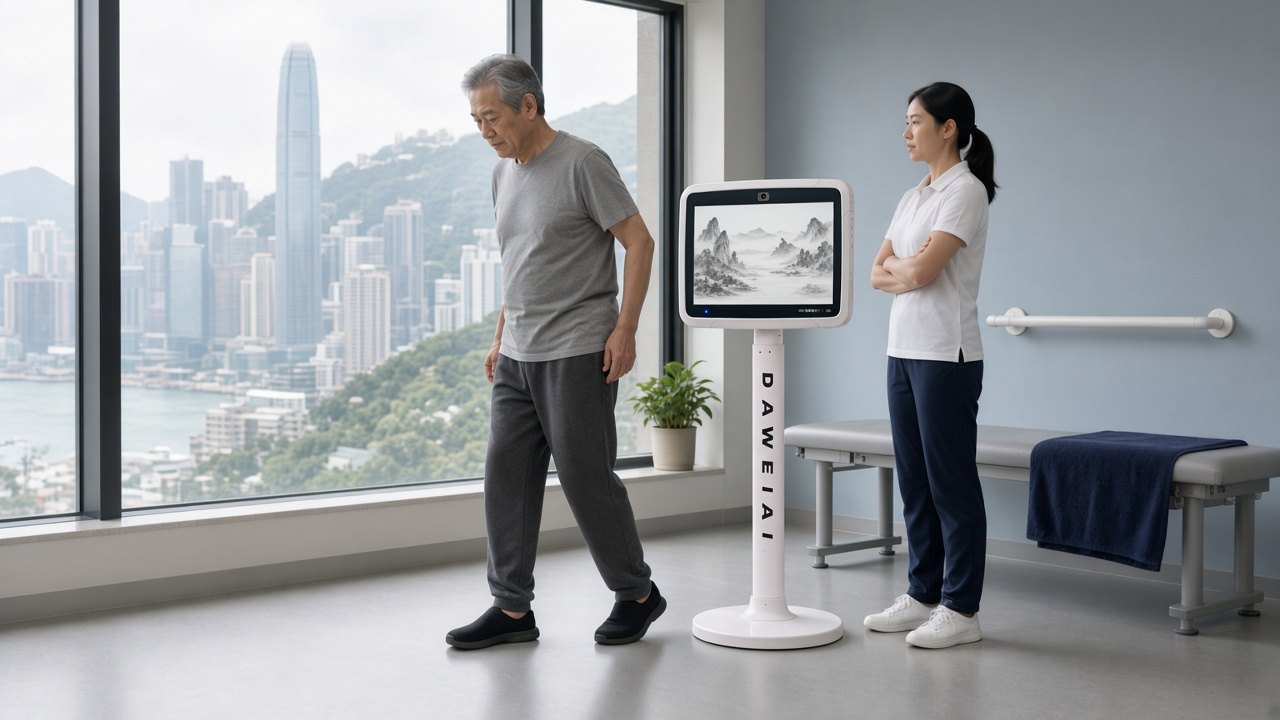
Falls and balance
Tai Chi asks for a slow shift of the centre of mass, step length, trunk turning and brief single-leg stability. Those match intrinsic factors in falls among older adults: poorer balance, weaker lower limbs and reduced proprioception.
A randomised trial by Li and colleagues in JAMA Internal Medicine (2018) enrolled 670 community-dwelling adults aged 70 or over who had fallen in the past year or whose mobility was impaired. Over 24 weeks, therapeutically oriented Tai Chi (Tai Ji Quan: Moving for Better Balance) had a fall incidence about 58% lower than stretching (incidence rate ratio 0.42) and about 31% lower than multimodal exercise (incidence rate ratio 0.69). A later analysis also found fewer serious injurious falls. The 1996 FICSIT study by Wolf and colleagues, and the 2019 Cochrane review by Sherrington and colleagues, place exercise that includes balance practice, including Tai Chi, among effective community falls-prevention methods.
Research by William Tsang and Christina Hui-Chan at Hong Kong Polytechnic University found that four to eight weeks of relatively intensive Tai Chi can improve balance control in older adults. Long-term practitioners had better knee proprioception, limits of stability and knee strength.
Those programmes had instructors and specified movements. They show that this kind of balance training is worth including in a service. They do not show that any single product reduced falls by 58%.
Musculoskeletal, cardiorespiratory and neurological rehabilitation
Wang and colleagues, in the Annals of Internal Medicine (2016), compared Tai Chi with physiotherapy for knee osteoarthritis. Both improved pain and function. Another trial, in the New England Journal of Medicine (2010), found that Tai Chi helped symptoms and function in fibromyalgia. A 2012 trial in the same journal, in Parkinson’s disease, found better postural stability with Tai Chi than with resistance exercise or stretching, and fewer falls.
In a heart-failure trial by Yeh and colleagues in the Archives of Internal Medicine (2011), the Tai Chi group had better quality of life, exercise self-confidence and mood than an education control. Six-minute walk distance and peak oxygen uptake did not differ significantly between groups. A citation should keep both parts.
Health qigong, mood and sleep
Baduanjin is a short health-qigong routine. Zou and colleagues pooled 19 randomised trials in 2017 and reported benefits for quality of life, sleep, balance, grip strength, flexibility, blood pressure and heart rate. Lower-limb strength, cardiorespiratory endurance and lung function were still unclear then. A 2026 meta-analysis of 18 trials and 1,527 older adults reported better sleep scores and depressive symptoms. A 2022 review of people aged 65 or over also warned that most studies were conducted in mainland China, so extrapolation should be cautious.
On cognition, a 2014 Tai Chi review by Wayne and colleagues suggested a possible mild to moderate benefit for cognitive performance in older adults. Trial quality varied, and it is not enough to claim prevention of dementia. A 2025 meta-analysis of Baduanjin and cognitive impairment included 7 trials and 539 people, with improvement in global cognition, memory and executive function. The included studies did not report adverse events related to practice. The authors still asked for stricter trials.
Longer answers: Health qigong and mental health and Baduanjin, mood and sleep.
The limit of online practice
Older adults currently meet Tai Chi, Baduanjin and Yijinjing mainly in four ways: public videos, live streams, community classes, and clinical groups led by a therapist. The first three solve access and company. They cannot see each person’s centre of mass and step length clearly. A clinical group has judgement, but time to comment person by person is limited. On-site routine feedback adds detail of the form. The system includes the Tai Chi 12 forms, Baduanjin and Yijinjing. Someone still has to decide whether that participant can stand. Comparison: Online and on-site.
Augmented-reality exercise games
Augmented reality lays cues on the real environment so a person receives game-like feedback while moving for real. A 2022 review of lower-limb rehabilitation included older adults, stroke and Parkinson’s disease. Results were at least no worse than practice without augmented reality, but devices and programmes differed widely. A 2023 meta-analysis found better balance-test scores in a sample of 199 people. It did not count falls. A 2025 review of virtual-reality exercise games for outpatient stroke found supervised clinic programmes more stable than home programmes. This product is not an augmented-reality game. See What is an augmented-reality exercise game.
Sources
- Li et al., JAMA Internal Medicine, 2018
- Sherrington et al., Cochrane, 2019
- Tsang and Hui-Chan, Hong Kong Polytechnic University
- Li et al., New England Journal of Medicine, 2012, Parkinson’s disease
- Wang et al., Annals of Internal Medicine, 2016, knee osteoarthritis
- Wang et al., New England Journal of Medicine, 2010, fibromyalgia
- Yeh et al., Archives of Internal Medicine, 2011, heart failure
- Baduanjin, sleep and depression, Frontiers in Public Health, 2026
- Baduanjin and cognition in older adults, 2025 meta-analysis
- Chang et al., augmented reality for the lower limb, 2022
- Scoping review of VR exercise games for outpatient stroke, 2025